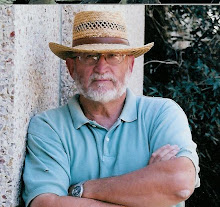
I have been thinking and writing about my visit to the Anasazi last week. I sat in the Great Kiva at Aztec Ruins (wrong name) listening to how the kiva was dated and what happened to the inhabitants thereof. It was a cool perpetual twilight in the kiva, which represents the underworld. Four strong pillars supported the roof, and there were benches around the circular walls for people to sit on.
And it's all gone. Piles of ordered stone stand where the people lived, and piles of rubble mark where nature has taken most of it back. As Tennyson said, the clock beats out the little lives of men. So, since it's Wednesday, I wrote a poem.
Ancestral Puebloans
One tick of the cosmic clock,
Two ticks, the Anasazi came
Waxed fat on the land then
Faded into a dusty puzzle,
Their works rounded and hooded
By eight centuries of
Sand, wind, tumbleweed.
Now I sit in a shadowed kiva
Surrounded by men in shorts
And sunburned knees, women in
Floral polyester wearing fanny packs
That say "Lost in Margaritaville."
Our guide quietly and surely strips
Any mystery from their going.
They outgrew the land,
Stripped it bare, raked it clean, then
Starved themselves into emigration.
For a moment we sit, pondering
The fate off these our cousins,
Our selves, and how fragile
The spiderweb of life is.
Then we remember --
There's an art sale in Taos.
We can make it if we hurry.
Wednesday, July 29, 2009

Tuesday, July 28, 2009
On left and right
When I first set up this blog, I assumed that political stances were a spectrum, with Liberal on one side and Conservative on the other. I had further assumed that I tended to slide back and forth on this spectrum, now little pink, now baby blue, now and then no color at all.
I've come to question this. It is, after all, a very one-dimensional way of looking at things.
There's a classic treatise called Flatland, that discusses, among other things, how the world must look to two-dimensional beings. They can see left and right, but not over. Wonderful discussion, and I think it might apply to political thought.
How, for instance, can I be at the same time an environmentalist and a hunter? A conservative who wants universal health care? A man who understands why fundamentalists do the things they do but would waste the whole tribe anyway?
I have a friend who believes the earth is 6000 years old. We go outside and see clearly, the striations in the landscape, the buckling of the earth, the eons-old erosion patterns, the seashells at 7000 feet. What about them? A cosmic quiz; God did it to test our faith.
If I'm liberal, I see things as a liberal sees them, in one dimension (ditto conservative, of course).
I think in order to see things straight, we need to see them widely, rather than narrowly.
I've come to question this. It is, after all, a very one-dimensional way of looking at things.
There's a classic treatise called Flatland, that discusses, among other things, how the world must look to two-dimensional beings. They can see left and right, but not over. Wonderful discussion, and I think it might apply to political thought.
How, for instance, can I be at the same time an environmentalist and a hunter? A conservative who wants universal health care? A man who understands why fundamentalists do the things they do but would waste the whole tribe anyway?
I have a friend who believes the earth is 6000 years old. We go outside and see clearly, the striations in the landscape, the buckling of the earth, the eons-old erosion patterns, the seashells at 7000 feet. What about them? A cosmic quiz; God did it to test our faith.
If I'm liberal, I see things as a liberal sees them, in one dimension (ditto conservative, of course).
I think in order to see things straight, we need to see them widely, rather than narrowly.
Sunday, July 26, 2009
Harmony in Nature
I had a mind-boggling experience today. I visited an Anasazi site in Aztec New Mexico (google Aztec Ruins New Mexico). It was mistakenly thought that the pueblo was Aztec, but it ain't. It was inhabited 1000-1200 by people that are called 'ancestral pueblo' by the Park Service, since Anasazi is a Navajo term that can be translated as "invaders."
Anyway, the question always comes up, 'Why did they leave?" And the answer can be found in Jared Diamond's book Collapse. They outbred and outpopulated their ability to sustain themselves, stripping the land for miles around them.
I mention this because of my belief that the Anasazi were pretty much the way we are. People are people, in all times and all places. If we wonder why such and such a society did something, we need only ask, "What would we do in a similar situation?"
I mention this because there are people who simply will not accept the explanation that the Anasazi ruined their environment, because they were a non-industrial people, and, living in harmony with Mother nature, couldn't possibly have done bad things to Mom. I have news for those people: They could have and did. Living in harmony with nature means being hungry, diseased, and probably eaten. The "Harmony with nature" philosophy that you hear from Native Americans is probably a modern romanticism about their ancestors, who only wanted to live a little while longer, and probably paid as much attention to their religion as we do to ours. Which is to say, almost none.
Anyway, the question always comes up, 'Why did they leave?" And the answer can be found in Jared Diamond's book Collapse. They outbred and outpopulated their ability to sustain themselves, stripping the land for miles around them.
I mention this because of my belief that the Anasazi were pretty much the way we are. People are people, in all times and all places. If we wonder why such and such a society did something, we need only ask, "What would we do in a similar situation?"
I mention this because there are people who simply will not accept the explanation that the Anasazi ruined their environment, because they were a non-industrial people, and, living in harmony with Mother nature, couldn't possibly have done bad things to Mom. I have news for those people: They could have and did. Living in harmony with nature means being hungry, diseased, and probably eaten. The "Harmony with nature" philosophy that you hear from Native Americans is probably a modern romanticism about their ancestors, who only wanted to live a little while longer, and probably paid as much attention to their religion as we do to ours. Which is to say, almost none.
Wednesday, July 22, 2009
Poetry today
It's poetry day today. Relax. I'm not going to give you one of mine, but one of the great ones of the English (or any other) language. I believe in rationality. I'm not always rational, but I believe in it. Further, I believe that our future, if any, depends on us finally becoming rational beings. I think that our Linnean name, homo sapiens, is a little presumptuous at present. So, here's the poem:
The Last Word
by Matthew Arnold
Creep into thy narrow bed
Creep, and let no more be said!
Vain thy onset! All stands fast.
Thou thyself must break at last.
Let the long contention cease!
Geese are swans, and swans are geese.
Let them have it how they will!
Thou art tired; best be still.
They out-talked thee, hissed thee, tore thee?
Better men fared thus before thee;
Fired their ringing shot and passed,
Hotly charged -- and sank at last.
Charge once more, then, and be dumb!
Let the victors, when they come,
When the forts of folly fall,
Find thy body by the wall.
Other than a slight overuse of the exclamation point, this is a wonderful poem and expresses exactly how I feel about my fellow beings.
The Last Word
by Matthew Arnold
Creep into thy narrow bed
Creep, and let no more be said!
Vain thy onset! All stands fast.
Thou thyself must break at last.
Let the long contention cease!
Geese are swans, and swans are geese.
Let them have it how they will!
Thou art tired; best be still.
They out-talked thee, hissed thee, tore thee?
Better men fared thus before thee;
Fired their ringing shot and passed,
Hotly charged -- and sank at last.
Charge once more, then, and be dumb!
Let the victors, when they come,
When the forts of folly fall,
Find thy body by the wall.
Other than a slight overuse of the exclamation point, this is a wonderful poem and expresses exactly how I feel about my fellow beings.
Tuesday, July 21, 2009
Why do people go to Hell?
I believe it was Andre Gide who said, "Hell is other people." I like that a lot. On the other hand, one must consider the flip side, "Heaven is other people," which Andre Gide did most emphatically not say.
Let's suppose there is a Hell, and let's stipulate that it's not a nice place. Dante made the lowest level of Hell a lake of ice, into which traitors were frozen.
Actually, Dante had a lot going for him. He realized that you can't just have one Hell. You've got to have several. One doesn't want to put a regular garden-variety adulterer in with biggies like Hitler and Saddam.
But I digress. The question is not where but why. And I'm going to take my clue from Gide. It's what we do to people, or rather, how we perceive ourselves in relation to other people. If you think that you are more important than a handicapped person, and deserve to park in their slot, then you are going to Hell. If you think that red lights are for other people, then you are going to Hell. If you think that you automatically belong at the front of a line, then you are going to Hell.
If you think that your waitress should ignore all the other customers, if you think that the person at the bank window has time to solve your addition problems, if you think that the store clerk should drop everyone else and help you decide between mauve and puce, if you think that it's important to shout into a cell phone in a restaurant, theater, or church, then you are most definitely going to hell.
I mean, how many of us commit really serious crimes? Among my acquaintance there are very few murderers, traitors, thieves, and the lot. It's the small things that are going to get us.
Let's suppose there is a Hell, and let's stipulate that it's not a nice place. Dante made the lowest level of Hell a lake of ice, into which traitors were frozen.
Actually, Dante had a lot going for him. He realized that you can't just have one Hell. You've got to have several. One doesn't want to put a regular garden-variety adulterer in with biggies like Hitler and Saddam.
But I digress. The question is not where but why. And I'm going to take my clue from Gide. It's what we do to people, or rather, how we perceive ourselves in relation to other people. If you think that you are more important than a handicapped person, and deserve to park in their slot, then you are going to Hell. If you think that red lights are for other people, then you are going to Hell. If you think that you automatically belong at the front of a line, then you are going to Hell.
If you think that your waitress should ignore all the other customers, if you think that the person at the bank window has time to solve your addition problems, if you think that the store clerk should drop everyone else and help you decide between mauve and puce, if you think that it's important to shout into a cell phone in a restaurant, theater, or church, then you are most definitely going to hell.
I mean, how many of us commit really serious crimes? Among my acquaintance there are very few murderers, traitors, thieves, and the lot. It's the small things that are going to get us.
Friday, June 26, 2009
Backsliding
I'm trying to be a liberal; I really am. I spend as much time as I can pitying poor people, that sort of thing. But this can only go so far. The other day, I was rummaging in a liberal blog and found a definition of a liberal. As far as I can remember after the shock wore off, there were things like, "A liberal is for the weak rather than the strong, for the poor rather than the rich, for the..." you get the idea.
Gosh that sounds noble. But think about it for a moment. Let's take the weak, for instance. Now, weakness (in the political sense) is not an absolute. It's a moving target that has to be constantly re-acquired. So, who decides? Some poor fool out there may not realize that he is weak and needs help, pity, and a pat on the back.
Other questions: Who decides what to do about it? Who pays?
I am suspicious of persons who are willing to make decisions about how other people are to be classified. There is a disturbing whiff of Puritanism about the whole process. I remember reading once (And I wish I knew who said this): "There are two kinds of people, the righteous and the unrighteous. The classifying is done by the righteous."
Of course, Liberals are going to say, "We are the ones who should classify and take action." What they are not going to say, but which hangs in the air like some old ghost, is "You can do your share by paying."
And why should Liberals be the ones who decide? Because they care. They said so. Does it make your skin creep a little to know that a goodly section of the population assumes control of other people because "they care"?
I've come up with a philosophical premise that covers this. It's this: The assumption of responsibility is an assertion of superiority. If you assume responsibility for dressing Aunt Martha, it's because she can't do it herself.
So, we come to the ultimate reason that Liberals care for people: It is their responsibility as the superior beings.
Conservatives, of course, simply say, "Let them decrease the surplus population." (stolen quote)
Frankly, I don't know which is worse.
Gosh that sounds noble. But think about it for a moment. Let's take the weak, for instance. Now, weakness (in the political sense) is not an absolute. It's a moving target that has to be constantly re-acquired. So, who decides? Some poor fool out there may not realize that he is weak and needs help, pity, and a pat on the back.
Other questions: Who decides what to do about it? Who pays?
I am suspicious of persons who are willing to make decisions about how other people are to be classified. There is a disturbing whiff of Puritanism about the whole process. I remember reading once (And I wish I knew who said this): "There are two kinds of people, the righteous and the unrighteous. The classifying is done by the righteous."
Of course, Liberals are going to say, "We are the ones who should classify and take action." What they are not going to say, but which hangs in the air like some old ghost, is "You can do your share by paying."
And why should Liberals be the ones who decide? Because they care. They said so. Does it make your skin creep a little to know that a goodly section of the population assumes control of other people because "they care"?
I've come up with a philosophical premise that covers this. It's this: The assumption of responsibility is an assertion of superiority. If you assume responsibility for dressing Aunt Martha, it's because she can't do it herself.
So, we come to the ultimate reason that Liberals care for people: It is their responsibility as the superior beings.
Conservatives, of course, simply say, "Let them decrease the surplus population." (stolen quote)
Frankly, I don't know which is worse.
Thursday, June 25, 2009
Magic, Still
We live in a universe with pretty regular laws. Oxygen is oxygen, even on Mars, and the absence or presence of oxygen can be pretty well and easily inferred from conditions on the planet. That is, if it has lots of oxygen, we can make a good hypothesis why. If we were able to travel to the center of the galaxy, we would find oxygen.
All these laws mesh together. The presence of oxygen determines what sort of life forms will evolve, whether or not things will burn, how much water there will be, and so on.
If I accept the postulates of magic, I have to assume a second set of laws, not connected to the ones we can verify. The laws of magic seemed to be based on an interesting concept: The word is the thing. If I can know the true name of a thing, I can control it. Similarly, the symbol for a thing is the thing. A doll is a person.
These laws of magic, on the other hand, seem to be spotty and not really uniform. Nor are they replicable. My best guess is that they are figments of the imagination. I will continue to think this until I am turned into a toad.
All these laws mesh together. The presence of oxygen determines what sort of life forms will evolve, whether or not things will burn, how much water there will be, and so on.
If I accept the postulates of magic, I have to assume a second set of laws, not connected to the ones we can verify. The laws of magic seemed to be based on an interesting concept: The word is the thing. If I can know the true name of a thing, I can control it. Similarly, the symbol for a thing is the thing. A doll is a person.
These laws of magic, on the other hand, seem to be spotty and not really uniform. Nor are they replicable. My best guess is that they are figments of the imagination. I will continue to think this until I am turned into a toad.
Subscribe to:
Posts (Atom)